NINJA RYUUKENDEN CHRONICLE: PART ONE
Developer Commentary by Hideo Yoshizawa (Sakurazaki)
|
|
In December 2023, former Tecmo staff Hideo Yoshizawa began a series of posts on X detailing Ninja Ryuukenden's development, of which he served as director of the Family Computer version. This is a compilation of those posts, presented chronologically in an easier to read format.
Note: Animated images can be paused by hovering the cursor over them.
|
TOP - PART ONE (1-12) - PART TWO (13-24) - PART THREE (25-34 + EXTRA)
[https://x.com/yoshi_clonoa/status/1733653081374740862]
2023.12.09 To commemorate the 35th anniversary of Ninja Ryuukenden, I'm going to attempt "Ninja Ryuukenden Chronicle" starting today.
Three years had passed since I joined Tecmo. Tecmo's president was a one-man administration who had single-handedly grown Tecmo into a mid-sized game company. He would suddenly come up with ideas and issue instructions to employees, and those became set in stone immediately.
After transferring departments from sales to development, I earned the president's trust by successfully directing Mighty Bomb Jack, my first project in the new role. And so he kept assigning me new challenges whenever the opportunity arose. Then one day, he called me in again.
"Ninjas are booming in America right now. So make a ninja game! Listen, make a game that goes 'ta-ta-ta-ta-ta-taaa'!"
The image that flashed through my mind at that moment was a ninja kicking off walls and scaling them. It was a scene with that exact "ta-ta-ta-ta-ta-taaa" kind of rhythm. And immediately, I ordered a ninja magazine from America.
[https://x.com/yoshi_clonoa/status/1734156545691443305]
2023.12.11 Upon reading, I realized that for Americans, ninjas appear to be a combination of magic user and kung fu artist. Because alongside shuriken and kusarigama, ninja gear also included nunchaku.
As I flipped through the magazine, an image of a ninja dashing through the nighttime cityscape flashed into my mind - a vision of him kicking off walls between buildings and scaling them to the rooftops.
So first, we prototyped a wall-kick jump. The specifications at that time were similar to Ninja-kun, and involved gripping the wall and repeatedly pressing the jump button while holding the D-pad in opposite directions.
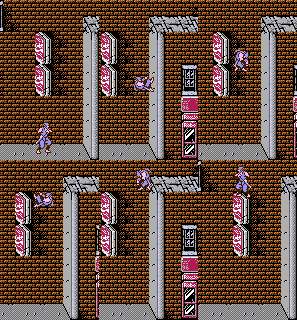 |
However, the final version had a programming oversight: after jumping and sticking to a wall, if the jump button was held down, simply pressing the D-pad left or right would cause the character to continuously kick off the wall and jump again.
But it felt incredibly comfortable. Just rapidly tapping the D-pad left and right allowed for speedy wall-kick jumps. And it had exactly the rhythm that I was looking for - that rapid-fire "ta-ta-ta-ta-ta-taaa" - so I decided to adopt it immediately. |
[https://x.com/yoshi_clonoa/status/1734358866354491684]
2023.12.11 Since this wall-kick jump defines the game's distinctive tempo, I wanted to design maps that make the most of this mechanic. That led to map layouts with lots of ups and downs.
When creating the game data, I drew inspiration from Akumajou Dracula, which I was playing obsessively at the time. However, the speed and tempo were different, and incorporating maps with elevation changes resulted in a completely different play experience.
Since ninjas naturally defeat enemies with ninjutsu, we designed a system of consuming ninjutsu power to use special techniques.
As the protagonist's normal attack involves close combat - slashing enemies in front with a sword - we thought power-up items should cover blind spots.
■ Shuriken [Throwing Stars] fly straight ahead, allowing attacks at a distance.
■ The Enba no Jutsu [Art of the Flame Wave] spreads diagonally upward and forward to attack.
■ When thrown, Fuusha Shuriken [Windmill Throwing Stars] track back toward the player. By skillfully dodging with jumps, you can swing them back and forth like a pendulum for continuous attacks.
■ This leaves only directly above and below you as blind spots, so we added a technique called the Kaiten Giri [Spinning Slash]. When used mid-jump, it grants invincibility and can hit multiple times.
[https://x.com/yoshi_clonoa/status/1735102632262590829]
2023.12.13 The basic concept of balancing power-ups is "one strength, one weakness". We designed items with different applications for each, and structured the stages accordingly.
The design philosophy for this game was "the ability to play seamlessly". The first thing the president mentioned, a game with a "ta-ta-ta-ta-ta-taaa" sound, made a lot of sense to me.
In other words, it's a game with a fast-paced tempo that flows without stopping. That's why we placed the suitable items in the proper places.
For example, if we positioned enemies that attack from diagonally above, we put an Enba no Jutsu just before them, or arranged enemies to attack from front and rear after placing a Fuusha Shuriken.
But because of that, trying to fight without using items makes it a terrifyingly difficult game.
(I saw [Shinya] Arino from Yoiko struggling with it on Game Center CX, and I thought, Man, he doesn't use any items at all.)
[https://x.com/yoshi_clonoa/status/1735475958986224036]
2023.12.14 The maps for Ninja Ryuukenden were drawn on Tecmo's special grid paper.
For each stage, we first determined how many screens wide it will be, then drew the terrain within that space. We drew while considering elevation changes and balancing visual appeal with difficulty.
Once the terrain was created, we set the order and types of enemies that appear. To create this data, I used a homemade screen scale.
I made this scale using thick paper cut into a window the size of one map screen. I slid it across the map to imitate scrolling. Since Ryuu, the player character, is positioned at the center of the screen, Ryuu would be at the center of the scale, allowing you to see the area of the screen the player is currently viewing.
When Ryuu arrived somewhere, I created data by imagining the action - like enemies appearing at a certain spot and charging at you.
Incidentally, enemy spawn points were set at the screen edges. Looking back, I should have made them spawn even further off-screen. That way, enemies wouldn't respawn just because the screen scrolled back a little.
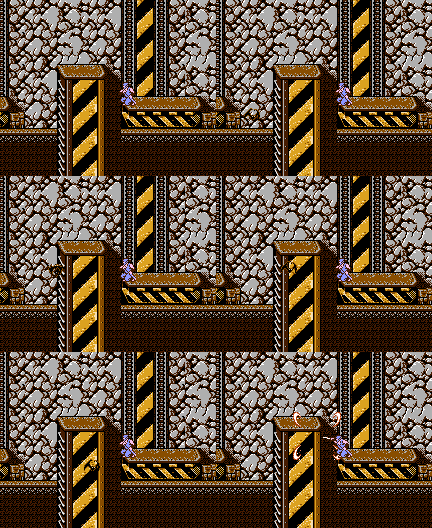 |
But back then, we didn't have that kind of know-how, so things ended up that way. But because of that, it's true that the game became one where you had to keep charging forward without looking back, never stopping.
That very quality became part of what made Ninja Ryuukenden so distinctive. It's ironic, really, because despite being called insanely difficult, it ended up captivating gaming enthusiasts of the time. |
[https://x.com/yoshi_clonoa/status/1735994904449536470]
2023.12.16 When creating the background [tile] data, we studied Konami's Akumajou Dracula.
Until then, Tecmo had stored data in a 16x16 block format. This was also the case with Star Force.
In Mighty Bomb Jack, the data was divided vertically into halves and arranged to create levels in the side-scrolling sections However, the visuals in Akumajou Dracula had less repeating elements.
After much research, it appeared that Akumajou Dracula stored data in 32x32 blocks. Four 8x8 tiles are combined to create a 16x16 data block, and four of these blocks are combined to form a 32x32 data block.
Maps were created by arranging these. Then, the programmer thoughtfully created a construction mode for us.
Pressing the Start button on the game screen displayed a 32x32 cursor. Move it using the D-pad, then hold the A button while moving the D-pad up or down to cycle through the 32x32 data in the preset order.
After repeating this process to create the map, pressing the Start button again made the ninja drop down from the top of the screen and land on the ground, allowing you to start playing immediately - a truly excellent feature. The ground collision data was stored in a 32x32 data block.
Using this to fine-tune the map and then play it to see if adjustments worked proved very effective for improving the map's quality.
While playing like this, I imagined scenes of enemies attacking in my head, then meticulously repeated the process of sketching them onto paper maps and inputting the data using the screen scale.
[https://x.com/yoshi_clonoa/status/1736189944501354745]
2023.12.16 One day, news broke that Namco would also be releasing a ninja game.
Mirai Ninja. Moreover, they were going to make a movie version directed by Keita Amemiya. "Don't lose to Namco!" Staff morale soared, and at the president's command, we were told to send a report to Famitsu.
At the time, it was the president's idea to call it "Ninja Gaiden" [Ninja Side Story]. I thought, Gaiden? But there's no main story yet? But the president was the kind of person who wouldn't listen once he'd made up his mind, so that was decided. Then, the very morning it appeared in Famitsu, the president called me.
"I saw it in print, but it lacks impact. Come up with an alternative! I'm heading over there (to the development building) now, so have something ready by the time I arrive!" Oh boy, this is trouble.
The president is driving from the Kanda headquarters in his Benz, rushing to the development building at Asakusa Honjo-Azumabashi. I only have about 15 minutes!
[https://x.com/yoshi_clonoa/status/1736562600153076077]
2023.12.17 What immediately came to mind was the kanji for "dragon". I figured a kanji with lots of strokes would be good since I needed something with real impact.
I immediately rushed over to the staff and said, "Let's make it about facing a mysterious organization with the power of a legendary sword called the Ryuuken... That's it! The protagonist's name is Ryuu! ...Ryuu Hayabusa, who travels alone to America to avenge his murdered father. Is that okay? So the title is 'Ninja Ryuukenden'! Right?!"
Just as I finished ranting, the president arrived. When I told him what had happened, he said, "That's fine! Let's go with that!" And just like that, the title was changed without a second thought. When pushed to the limit, people can be surprisingly creative.
Incidentally, overseas it was titled Ninja Gaiden, deliberately using kanji for "gaiden" with the ruby reading "GAIDEN". This was also the president's idea.
"Americans love kanji!" And so, I ended up coming up with a story involving a mysterious organization and the CIA, centered around the Ryuuken and the Jashin [Evil God] statue.
[https://x.com/yoshi_clonoa/status/1736894565821645287]
2023.12.18 Today's topic is the intermission animations.
I've always loved movies and anime, had a strong interest in visual expression, and constantly wanted to fuse story, visuals, and gameplay. Naturally, I became passionate about crafting the intermission scenes. I called it "Cinema Display"!
Back then, games primarily used static cutscenes - single-image slideshows - for interlude scenes. For games, the story was just a bonus feature. This was true for arcade games and Famicom games alike.
I absolutely loved movies and always wanted to work in filmmaking, but I never managed to make it happen. So I kept wondering: Why doesn't everyone use the Famicom's capabilities to create cinematic camera work and directing?
When I ended up helping out with Captain Tsubasa, which my colleague was directing, I brainstormed various ideas about visual expression, worked on the staging of the story parts, and experimented.
I studied hardware characteristics and program mechanisms a bit. Then I started drawing up storyboards, thinking If I prepare the artwork like this and run it with this mechanism, it'll turn out like this! When I did that, the staff went "Whoa!" and were amazed.
[https://x.com/yoshi_clonoa/status/1737257974333362202]
2023.12.19 I spliced in a cutscene purely to surprise the staff.
Watching the staff react in amazement was so enjoyable that I kept getting more and more into it. I combined backgrounds and [sprite] objects to express depth, and used raster scrolling - where you change the scroll speed mid-scanline - to create a three-dimensional effect.
I believe these expressive techniques were largely learned from Japanese limited animation. For instance, unlike Disney's full animation, Japanese animation developed methods to express movement and camera work through techniques like panning the backgrounds or sliding cels to minimize the number of cels used.
Therefore, this limited animation technique proved extremely useful for the Famicom, which had very limited functionality and [memory] capacity.
Ultimately, about half the capacity was allocated to Cinema Display. I don't think there was any other game at the time that put this much effort into cutscenes. Especially since they didn't use cinematic camera work.
Anyway, I wanted to create a game that felt like a movie, so I lavishly allocated capacity to Cinema Display. But of course, if I just drew pictures without thinking, I'd exceed the capacity limit in no time. So I tried all sorts of tricks to pack in as much as possible.
[https://x.com/yoshi_clonoa/status/1737626282781999593]
2023.12.20 Know-how about Cinema Display.
The picture is widescreen like CinemaScope. Placing a close-up of a face here allows you to compress the character significantly by treating the eyes and mouth as objects. Plus, close-ups are impactful, and stand out even as small photos in magazines. Combining this with character changes via objects enables eye contact and lip-syncing - killing three or four birds with one stone.
Furthermore, by utilizing a variety of bust shots, you can scroll or move this object up and down to depict the movement of parts not visible on screen. Additionally, by altering the scrolling direction and speed relative to the background, you can express various camera movements.
While we focused heavily on the story and visual expression, our top priority was always remembering this was a game. Since it's a game, the core must remain gameplay. Cinema Display absolutely couldn't get in the way - that would be putting the cart before the horse.
I believed that required keeping players emotionally invested. Players are most excited when they first buy the game, so sustaining that excitement is essential.
[https://x.com/yoshi_clonoa/status/1737989570430705958]
2023.12.21 Cinema Display isn't something you can just throw in anywhere.
After the excitement of the opening sequence leads into the game, players quickly get used to the controls, smash through enemies, and rush forward to defeating the boss at the stage's end. Then, a cutscene kicks in to build dramatic tension for the next phase.
Therefore, it's necessary to have shorter sections that players can reach without too much struggle, followed by longer Cinema Display sequences with unexpected developments after the toughest challenges. I wanted players not just to clear each stage sequentially, but to empathize with the protagonist Ryuu's feelings and carry that emotional state into the next stage.
And for the highlights, we prepared a wide-scope Cinema Display that fills the entire screen. The scene where Ryuu looks out from the cliff top at the distant enemy castle is one such example.
This uses a background image depicting the castle and part of the cliff in the foreground. By scrolling the castle and cliff in opposite directions with a raster scroll, it creates the illusion of the camera panning around. The upper part of the cliff and Ryuu are drawn as objects. By scrolling them in sync with the lower background cliff, the seam in the background raster is made unnoticable.
For the ending, I created a scene where the sun rises vertically from a raster-split horizon, and the color changes as dawn breaks. This full-screen Cinema Display is a special touch, so I only used it these two times. I felt it would be more effective that way.
And since no other Famicom software had gone this far at the time, just this alone drew a lot of surprised reactions from magazines and users back then. It's not that unusual now, though. The significance lies in the fact that it was done on the Famicom.
TOP - PART ONE (1-12) - PART TWO (13-24) - PART THREE (25-34 + EXTRA)
|
|
|