NINJA RYUUKENDEN CHRONICLE: PART TWO
Developer Commentary by Hideo Yoshizawa (Sakurazaki)
|
|
In December 2023, former Tecmo staff Hideo Yoshizawa began a series of posts on X detailing Ninja Ryuukenden's development, of which he served as director of the Family Computer version. This is a compilation of those posts, presented chronologically in an easier to read format.
Note: Animated images can be paused by hovering the cursor over them.
|
TOP - PART ONE (1-12) - PART TWO (13-24) - PART THREE (25-34 + EXTRA)
[https://x.com/yoshi_clonoa/status/1738355973662921196]
2023.12.22 About half of the ROM capacity was allocated to the Cinema Display feature. But no other game allocated such a significant portion of its limited capacity to presentation.
That said, it would have been counterproductive if the core gameplay suffered in comparison to other games, so I focused on how to use the remaining half of the capacity efficiently and without waste.
I went directly to the visual staff's desks, asked to see the artwork they were creating, and worked with them to find ways to reduce the number of data points used, even if only slightly.
For areas where just one dot was sticking out, I adjusted the angle slightly to make it fit. For objects, I identified where savings could be made by shifting the placement data by one dot at a time.
 |
As time went on, this frugal approach became second nature to the visual staff, and they began creating images that delivered maximum impact with minimal data - even without being told. On the Famicom, a system with extremely limited capacity, the difference in visual quality between developers who employed these techniques and those who didn't was starkly evident. |
That's why I believe Tecmo's visuals at the time reached a quality level that rivaled Capcom, who were considered one of the industry's best. In fact, our visual goal back then was to surpass Capcom!
[https://x.com/yoshi_clonoa/status/1738726726199583195]
2023.12.23 Development was proceeding smoothly. Until one day...
After Ryuu could run, perform wall-kick jumps, and unleash ninjutsu, I was summoned to the president's office once again, as per usual.
The moment I walked into the room, I instantly sensed the atmosphere. Something's wrong here.
"I heard from manager O. that the ninja's running form has turned into an 'upright run'! Is that the case?!"
The president already had a naturally loud voice due to his hearing loss in one ear, but this time it was even louder, radiating an intimidating presence.
Still, what exactly is an "upright run"? I don't know, but from the sound of it, I somehow understood it meant a clumsy way of running.
"I don't think that's the case though..."
The moment I retorted, BOOOOOM! I struck a nerve with the president, who yelled at me even louder. He was ranting at me, but it sounded like distant thunder - I felt so faint I couldn't make out a word he was saying.
[https://x.com/yoshi_clonoa/status/1739088729434890275]
2023.12.24 The president scolded me for the ninja's running form.
It was clear that something had to be done to resolve this. So I was discussing changes to the character's running animation with the visual designer. What exactly was the problem? This won't do, that won't do either.
Then the president came over. His mood had completely changed from his earlier fury, and he was now in a good mood. He looked at the running animation on the screen and said, "Oh! That's much better now, isn't it?"
"Uh, I haven't changed anything yet..."
He looked embarrassed, replying, "Well, I thought from what manager O. said he'd look more clumsy, but he's not really like that at all."
The visual designer T.-kun's words at that moment were brilliant. "No way! If even one person saw it that way, I'll redraw it! It'll be even better!"
"Alright then, I'm counting on you!"
The president hummed a tune as he walked away. In the end, after redrawing it, it turned out even cooler.
At the time, I thought it was a bit much, but looking back now, I realize that the president, the department managers - no, every single employee - had a deep interest in the products being created within the company. They all wanted them to be even better, to sell well. I think it's truly fortunate that every single product was so important, both to the company and to the team.
Tecmo was a mid-sized company with about 200 employees, and its development department was also small, with only 20 to 30 people. But each and every title developed held the company's fate in its hands, and looking back now, I think that was a good thing.
Meanwhile, at Namco/Bandai Namco, over 100 games were released annually, with twice that number in development. While this scale offered advantages, only a fraction of those products held the company's fate in their hands. To gain attention within the company, one had to climb the ranks on their own.
[https://x.com/yoshi_clonoa/status/1739432284334539106]
2023.12.25 Today's topic is visuals.
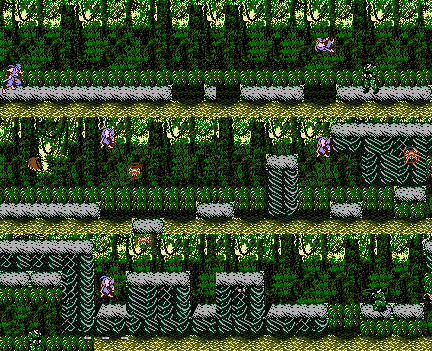
There's a jungle stage partway through, and the gaps in the ground on that stage are swamps that count as a miss if you fall in. T.-kun, the visual designer, was bragging about the color of those swamps. "This color is a shade that's rarely been used in other Famicom software!"
The Famicom is said to have 64 colors, but in reality, some colors cannot be displayed even when specified, making it 54 colors. Furthermore, the colors are not evenly distributed across RGB; there are many shades of red, but few shades of blue. That's why there are so many games with brick-like backgrounds.
Since the image is expressed using only a limited combination of colors, the overall color scheme and quality are determined by which colors are chosen for each palette. That's why the designer's sense really shows through, resulting in marked differences in quality between each piece.
 |
I believe artists of that era were truly judged by their sense of color selection. In that sense, Tecmo's artists were outstanding.
Back then, we competed fiercely, thinking, "Don't lose to Konami in programming! Don't lose to Capcom in art!" |
[https://x.com/yoshi_clonoa/status/1739798120312213703]
2023.12.26 A new member joined!
Shortly after the ninja project was launched, there was an interview for a mid-career recruitment, and I ended up conducting it alone. He had previously worked as an animator at Gainax, and since he could draw, he applied for the graphic artist position.
Tecmo had four planners, and while the other three could all draw, I was the only one who couldn't. That's why the role of interviewer for my team was assigned to me.
The interview was all about anime and movies, but since we seemed to share similar interests, I hired him. His name is Katou-kun, and he went on to work at Square, where he was responsible for the scenarios for Chrono Trigger and Chrono Cross. More recently, he's been active working on GREE's Another Eden.
[Katou-kun: Masato Katou, credited as Runmaru/Runmal]
He was immediately assigned to the Ninja Ryuukenden project, tasked with creating enemy graphics. Compared to the work of an animator who brings predetermined artwork to life as video, the freedom to draw game visuals based on his own sensibilities must have been deeply rewarding.
He kept coming up with one original design after another. That spinning kung fu guy and bouncing gargoyle - they were all his ideas.
What I found fascinating was how, when I described an enemy's movement specifications, he would adapt them and then illustrate them with unexpected ideas. The boxer that appears on the first stage, for example, was an enemy I added based on his artwork. Through this back-and-forth, the enemy concepts kept expanding.
For him, a former animator, the Cinema Display feature - a visual scene that consumed an unprecedented amount of memory for a game - must have been like a fish in water. He found the anime-style direction incredibly entertaining.
The heroine Irene was also designed by him. When I saw that distinctive hairstyle, I immediately recognized it as Rachel from Blade Runner, but the other staff didn't notice. Since Blade Runner is one of my favorite movies too, I just left it at that. Did you notice?
[https://x.com/yoshi_clonoa/status/1740168736768987184]
2023.12.27 In Cinema Display, during scene transitions, a title such as "Chapter One: Destiny" and an illustration slide in, accompanied by a short BGM [background music] sequence.
This is what's called an "eye-catch". I've loved anime since high school and used to watch shows like Lupin Sansei, Kidou Senshi Gundam, and Mirai Shounen Conan all the time.
In those anime, similar eye-catch sequences are inserted before and after commercials. I thought they were incredibly cool and had great pacing, so incorporating them into the game felt perfectly natural.
However, this kind of staging seemed quite rare at the time and was very well received. Moreover, once we tried it, we realized it also served as a natural break in the action and was convenient for scene transitions during the story's progression.
In this way, the presentation of Ninja Ryuukenden is heavily influenced by the techniques of anime I watched during my student days.
[https://x.com/yoshi_clonoa/status/1740539164683362738]
2023.12.28 Today's topic is sound.
I absolutely love the sound in Ninja Ryuukenden - it's packed with fast-paced, cool BGM tracks. Fans also rave about the BGM, so it definitely plays a big part in the game's popularity.
To the sound staff, I conveyed that the goal for the BGM was to capture the image of Ryuu, burdened by destiny, charging headlong into battle against a colossal evil, and requested music with a brisk tempo.
And since there's a story, I'd explain each stage's situation and Ryuu's feelings to have the music composed. Once it was finished, I'd get a call, listen to it, and talk about what images came to mind when hearing the piece. That would decide whether it got used for another scene or scrapped.
So I think we actually created about twice as many songs as were ultimately used. I'm sure I came across as a director who was very particular about music. I always made decisions by imagining how it would feel when that song played over footage of Ryuu being controlled in the background of a stage, defeating enemies and charging forward.
That's because I believe BGM has a significant impact on shaping the player's psychology in games. Furthermore, in Cinema Display, we sometimes even specified the exact timing and tempo of sound effects.
However, since the BGM requests were designed to be directly written into the program by the programmer, it was ultimately programmer Y.-kun who made the final requests. Y.-kun would listen to the BGMs that had been completed multiple times and sometimes request tracks that weren't the ones I and the sound director had specified for a particular stage.
There were times when I'd burn the ROM and be shocked when I played it. Personally, I didn't care much as long as the atmosphere and pacing weren't off, except for a few crucial scenes. But I think the sound designer was furious.
[https://x.com/yoshi_clonoa/status/1740886932476088703]
2023.12.29 This time, we'll talk about difficulty.
Ninja Ryuukenden became famous for being "extremely difficult", but that wasn't the intention.
At the time, we were in the final stages of adjustment. We set up enemy tables and configured item data, carefully tuning things so that useful items would appear for countering enemy movements, and item attacks would allow for fluid gameplay.
The criteria for determining difficulty at that time were based on myself and the staff. One of the visual staff was a hardcore gamer, and he cleared it without any trouble, saying it was incredibly fun.
Also, I've always been pretty bad at video games, but back then, even I could clear it, if it meant staying up all night and rubbing my tired eyes while playing. So I even tried intentionally delaying my button presses and slowing down my reactions while playing. And yet, I could still clear the game.
So I thought the difficulty was just right.
But that's because I created the enemy spawn data myself, isn't it? No matter how clumsy I am, and no matter how slow my reactions during play, I can't erase the fact that I know exactly where and what will attack me.
Staff members have played hundreds of times since the early stages of development and are accustomed to it. But users haven't suddenly played hundreds of times, so we shouldn't base the difficulty level on staff playthroughs.
As a result, the final product ended up being labeled as insanely difficult. Since then, we've always made sure to have a "debug virgin" - someone who knows absolutely nothing about the game's content (like someone from the administrative department) - ready to play it during the final adjustment phase.
[https://x.com/yoshi_clonoa/status/1741259437103550706]
2023.12.30 Today we'll delve into the truth behind this game, notorious for its extreme difficulty level.
In the opening, the man who dueled our father, Jou Hayabusa, stands in our way later as the masked villain known as Bloody Mars. Anyone who's played the game won't forget this guy's line.
"If you proceed beyond this point... you will come to know... hell on earth..."
From here on, the game enters its final stretch, with a series of high-difficulty stages leading straight to the final bosses: Jaki-Ou [Demon Lord] and Jashin. However, if you lose to any of the final bosses, you'll be sent straight back to the Bloody Mars spot.
I'm truly sorry... I'm sure many of you must have given up right here. With the story nearing its climax, I imagine it was especially painful not being able to proceed further.
But in the original design, if you lost to the final boss, you'd restart from the entrance to the hallway just before that boss's room. We placed a power-up item in the final hallway, so we wanted players to pick it up and try the boss fight again.
But when I checked the ROM, it was set up to kick you back too far. This is brutal. What a terrifying bug, I thought.
I immediately went to report the bug to programmer Y., but his response was astonishing. "No! This is fine! The passage in front is way too easy!" He refused to budge. We argued back and forth, but in the end, he wouldn't fix it, and it became part of the master copy as is.
That said, it's my responsibility for failing to stop the programmer's reckless actions. I'd like to once again apologize to everyone who played this game. I'm sorry.
And so, it was dubbed "extremely hard" by magazines and drove Game Center CX's Section Chief Arino into a state of utter bewilderment.
[https://x.com/yoshi_clonoa/status/1741654350626533851]
2023.12.31 Have you noticed that the stages in Ninja Ryuukenden are arranged chronologically, depicting the passage of time throughout a single day?
In the first chapter, Ryuu, having crossed the ocean alone to America to carry on his father's will, races through a downtown high-rise area at night. After defeating the boss at Jay's Bar, he is shot by a mysterious woman and loses consciousness, waking up in a jail cell early the next morning.
After escaping the enemy base, he'll emerge in Death Valley. Meeting his father's friend Mr. Smith, will be around 8 AM. Pursuing the stolen Jashin statue through the lake and snowy mountains will take place around 9 to 10 AM.
He'll land in the Amazon around 4 PM, and climb the cliff in Chapter 5 around 7 PM. As he climbs the cliff, the sun begins to set, and by the time he confront Bloody Mars, it's 8 PM.
The confrontation with Jaki-Ou was set for around 2 AM the following day, with the castle sinking after all enemies were defeated by around 5 AM, leading into the ending scene of the sun rising. I conveyed this to the visual staff and had them gradually change the color of the sky.
Please play again, keeping that in mind!
[https://x.com/yoshi_clonoa/status/1742010974998335868]
2024.01.01 Nintendo formed a group called the Shoshinkai, gathering wholesalers and retailers, and regularly held its own business meetings with them.
There, products from various companies were displayed, and salesmen from each company served as guides, providing product explanations and promoting sales to wholesalers and retailers.
From among the exhibits, Nintendo had selected several products they particularly wanted to focus on supporting sales for, and these were to be displayed at the cylindrical display area in the center of the venue.
Naturally, it attracted a lot of attention and significantly impacted order volume, but it ultimately depended entirely on whether Nintendo chose to feature it, so we had no control over it whatsoever.
And then Ninja Ryuukenden was selected as a product to be displayed in that symbol tower. Thanks to that, it earned a good reputation among wholesalers and retailers, resulting in orders for 300,000 units.
Nintendo has always been very supportive of Ninja Ryuukenden. This is evident from its inclusion in the Nintendo Classic Mini: Family Computer and its feature in the Famicom timeline on the Famicom 40th Anniversary website.
[https://x.com/yoshi_clonoa/status/1742348986223415751]
2024.01.02 Ninja Ryuukenden was a product manufactured under OEM [Original Equipment Manufacturer] by Nintendo.
In other words, it's a system where programs are submitted to Nintendo, manufactured at Nintendo's factories, delivered as finished products, and then shipped to distributors.
At that time, Nintendo would debug the submitted programs independently. Essentially, this involved inspections that included quality checks for software running on Nintendo hardware. If a title failed these checks, it couldn't proceed to production, and its release date could be postponed.
The organization responsible for that verification was Nintendo's debugging department, known as the Mario Club. These debugging reports naturally documented discovered bugs, their frequency, circumstances, and predicted causes. Beyond that, they also included additional observations and requests.
In the case of Ninja Ryuukenden, no bugs that would've halted production were reported, but one request was that "It would be better to have stages where the ninja swims underwater."
Since Super Mario had underwater levels, I believe that's why such requests emerged. However, I decided not to implement it because at that point it would've been impossible, plus I felt that sluggish underwater movement actions simply wouldn't fit the tempo of this game.
TOP - PART ONE (1-12) - PART TWO (13-24) - PART THREE (25-34 + EXTRA)
|
|
|